

Published by
Share


How to Build a Cross-Functional Product Development Team With Nearshore Talent
- Nearshore Software Development
08 July 2026
Most tech leaders struggle to build balanced teams that can ship complex software products. When your internal pipeline is dry, your time to market slows to a crawl. Book a Discovery Call with Teravision to learn how a cross-functional nearshore team can accelerate your product delivery starting in as little as two weeks.
A cross-functional product development team is a group of experts with all the skills needed to design, build, and ship a software product. This unit usually includes developers, designers, and testers who work together in real time to solve complex problems and deliver high quality results. For many North American firms, a nearshore partner is the fastest way to get these skills and cut time to market by 30 to 50 percent. According to Deloitte, 70 percent of companies choose nearshoring to find talent and grow their engineering teams three to five times faster. A partner like Teravision Technologies brings 20 years of experience and elite talent that shares your time zone, culture, and business goals.
Building a team that works well together is the first step toward shipping great products. Understanding what this model looks like in practice is the best place to start.
What Is a Cross-Functional Product Development Team?
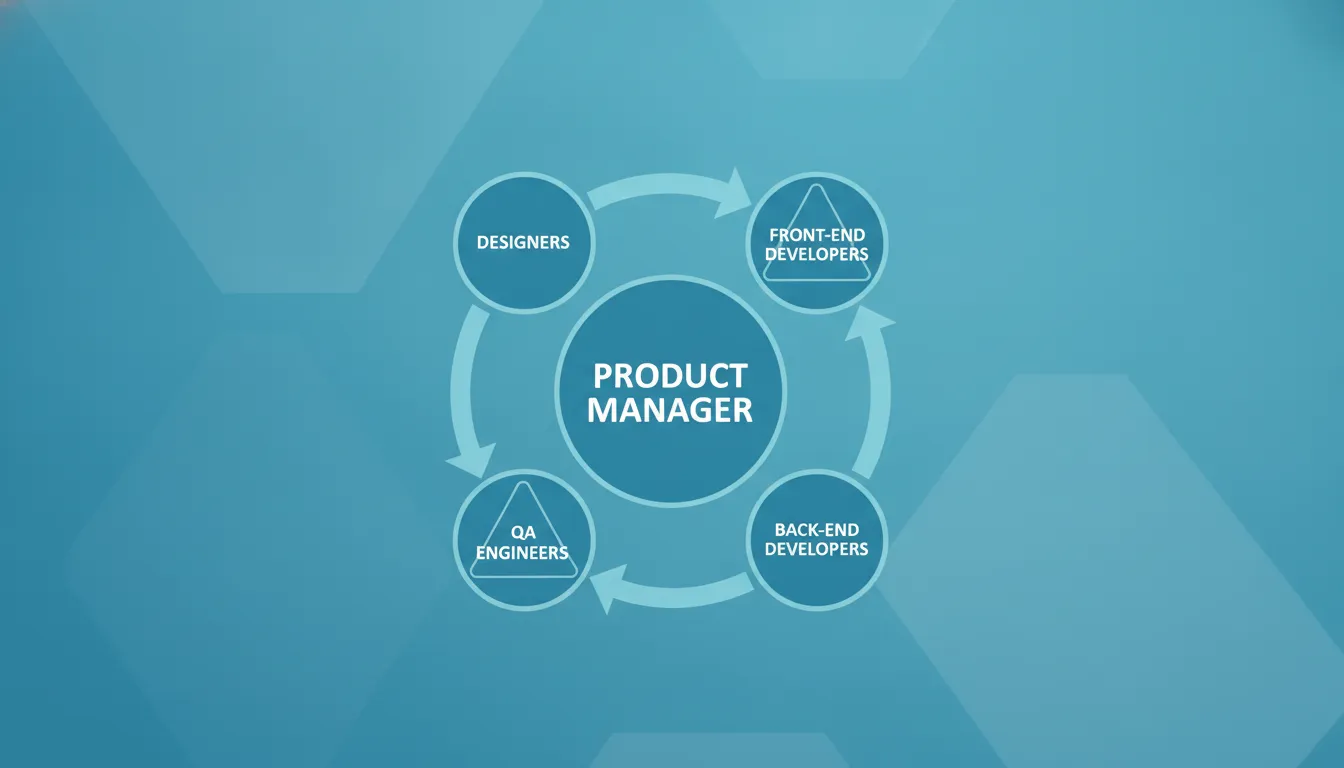
A cross-functional product development team brings together engineers, designers, product managers, and QA specialists who own the full lifecycle of a software product from concept to deployment. Unlike traditional siloed structures where work passes from one department to the next, these teams collaborate in real time, solving problems as they emerge rather than after handoffs create delays.
A cross-functional product development team is a group of people with different skills who work together toward one common goal. Instead of operating in separate groups, these experts form a tight unit to build a single software product. This team usually includes software engineers, designers, product managers, and quality experts who work on the same plan. They might also have experts in security or cloud systems based on the needs of the project. This model replaces the old way where each group worked alone in its own area.
In the old siloed model, designers often finished their work and passed it to coders without much communication. Coders then sent the work to testers who found bugs that sent the task back to the start. These loops created significant delays that hurt business velocity. A cross-functional product development team works together at the same time to avoid these costly gaps. This mix of skills helps the team solve complex product problems faster than siloed groups can.
Diverse Skill Sets and Roles
Building a great product needs many types of talent to work in total sync. A typical unit has front-end and back-end developers to write the code. It also needs a product manager to set the vision and a lead to manage the process. Designers ensure the product is easy to use, while testers find bugs before the product reaches users. When these professionals work as one, they can share ideas early and catch issues before they grow.
This structure allows the team to handle every part of the product lifecycle without outside help for most daily tasks. This autonomy is essential for an agile nearshore development team to reach its goals. By housing all capabilities in one group, the team can move from concept to deployed feature much faster than a distributed department model allows.
Why Collaboration Outperforms Simple Staffing
Many leaders think staffing is about filling open seats with qualified resumes. But real success comes from how well those people work together day to day. Research shows that collaboration is essential for team success in complex work settings. It is not just about individual knowledge, but about how the group blends their expertise.
The best teams use clear practices and shared rules to keep everyone aligned. They align individual talents with the shared goals of the project to ensure the best outcome. This combination of talent and process helps the team reach its full potential during a build. Team assembly involves finding the right set of experts to maximize results for the client. This approach turns a group of strangers into a high-output unit that can handle any challenge.
Reducing Dependencies for Speed
Modern software needs to ship fast to keep up with market changes. Siloed teams often get stuck waiting for answers from people in other buildings or time zones. One group might wait weeks for another to complete a small task that blocks their progress. A cross-functional unit removes these blocks because the experts are always in the room. They can make decisions on the spot and keep work moving forward.
This lack of barriers is a key reason for using nearshore software development models today. Teams can communicate in real time and resolve issues as they happen without lag. Faster problem-solving produces a much faster path to market for the new product.
Why Is Nearshore the Smartest Path to Cross-Functional Teams?
Nearshore partnerships offer North American companies the fastest route to building cross-functional teams by combining time zone alignment, cultural compatibility, and cost advantages that offshore or local-only hiring cannot match. The result is a team that integrates seamlessly with your existing operations from day one.
Many North American firms now face a tough choice. They must decide between hiring local staff, using offshore teams, or partnering with nearshore providers. For many organizations, nearshore is the clear winner. This model offers a blend of speed, cost, and skill that is difficult to replicate through other approaches.
Real-Time Teamwork Across Time Zones
One of the biggest advantages of nearshore work is time zone alignment. Most nearshore hubs in Latin America operate on EST or CST. This means your team can communicate in real time throughout the business day. You do not have to wait until the next morning for an answer to a critical question or a new idea. This shared schedule is essential for agile workflows. It keeps your product moving fast without the delays that come with offshore models.
A study from the Everest Group shows that North American firms now prioritize agile compatibility and geographic proximity. They want teams that can participate in daily stand-ups and solve problems as they emerge. This real-time connection makes it easier to keep everyone aligned. It also builds trust between your in-house staff and your nearshore squad.
Cultural Fit and Agile Success
Nearshore teams share a similar work culture with Western firms. They use the same tools and follow the same agile practices. This compatibility makes integration straightforward. You do not need to spend weeks teaching them how your business operates. They understand the context behind your decisions, which helps them work more independently.
Team success depends on more than technical skills. It requires people who collaborate effectively. A study on team effectiveness confirms that members must work well together to hit their goals. Nearshore teams bring this collaborative ease. They speak your language and share your objectives. This cultural alignment helps you avoid the friction that can stall a complex product build.
Faster Time-to-Market at Lower Cost
Cost and speed are both critical factors. Nearshoring helps you achieve both. You can save 30 to 50 percent on costs compared to local hiring in the U.S. or Canada while simultaneously accelerating delivery. Deloitte data confirms that companies using nearshore partnerships see time-to-market improvements of 30 to 50 percent. At the same time, you get to market faster. This advantage is vital in a landscape where new applications and tools launch constantly.
High Adoption and Market Growth
Deloitte reports that 70 percent of firms use nearshoring to find top talent rapidly. Statista projects the nearshore market will grow at over 12 percent annually for the next five years. This growth signals that more leaders recognize the value of this model. To learn more about how this approach works, read our nearshore software development guide. By choosing a nearshore partner, you access the talent you need to win without the high costs or slow timelines of other models.
Dedicated Team vs Staff Augmentation: Which Model Is Right for Your Project?
The choice between staff augmentation and a dedicated team depends on your internal capacity, project scope, and the level of ownership you want your partner to take. Each model serves a different strategic need, and understanding the distinction helps you avoid costly misalignment.
Building a cross-functional product development team requires a strategic choice between two main service models. You can either add talent to your existing group or hire a complete unit to own a project. Each path has distinct effects on team cohesion and delivery speed.
Understanding Staff Augmentation
Staff augmentation is a fast way to fill specific gaps in your roster. You manage the new workers directly and assign them tasks within your current sprints. This model works best when you already have strong lead engineers and a clear roadmap but need extra hands to meet a deadline. It is often a smart choice for short projects or when you need a very specific skill for a small feature.
This model allows you to get help quickly, but it places the burden of project management on your internal leads. Because external workers join an existing culture, they may not feel the same sense of ownership as your core staff. However, clear communication and goal alignment can help these blended teams succeed in high-pressure settings. View our staff augmentation services to learn more about how this model works.
The Power of Dedicated Teams
A dedicated team is a full, self-standing squad that takes on entire product goals. At Teravision, our squads include developers, designers, QA testers, and project leads who own the final results. This structure provides the stability and deep technical knowledge needed to scale complex product architectures over many months. These teams integrate more deeply with your business because they work as a single, cohesive unit focused on your vision.
Because these squads have worked together before, they skip the awkward phase of learning how to collaborate. They follow established practices that maximize their effectiveness from day one. Scientific research shows that effective team composition involves grouping individuals with relevant expertise to meet specific goals. A dedicated squad does exactly that by bringing a pre-built engine of talent to your product roadmap.
Choosing the Best Fit for Your Project
Choosing the right model depends on your internal capacity and the scope of your product. If you need to scale a core product from the ground up, a dedicated team offers more long-term value and better accountability. If you just need to fix a few bugs or finish one specific screen, staff augmentation is a more agile tool. At Teravision, we offer a two-week ramp-up for new members to ensure you can start work without long delays.
| Criteria | Staff Augmentation | Dedicated Team |
|---|---|---|
| Team Cohesion | Low to medium; requires onboarding | High; pre-built functional unit |
| Accountability | Client manages outcomes | Partner owns delivery results |
| Sprint Planning | Managed by client leads | Handled by squad leadership |
| Cultural Integration | Worker joins client culture | Shared culture with deep alignment |
| Ramp-up Time | Fast for specific tasks | Ready for full project launch |
Our engagement terms are also flexible, with month-to-month options that let you adjust your team size as your needs change. This flexibility allows you to pivot between models as your product matures or as your market needs shift. Whether you need a few engineers or a full squad, the goal is to build a team that can solve problems fast and ship high-quality software.
How Should You Structure Your Cross-Functional Nearshore Squad?
An effective nearshore squad includes every role needed to ship production software: engineers, designers, QA specialists, and a dedicated project lead who owns agile delivery. Getting the composition right from the start determines whether your team ramps in two weeks or two months.
Building a cross-functional product development team takes more than hiring people with the right technical skills. To succeed, team members must work well together and focus on a single goal. We build squads that own the product plan and deliver using agile methodologies.
Core Roles in a Product Squad
Each squad we build has every role needed to ship a product. A good cross-functional product development team includes engineers, designers, and testers. We also add a project lead to manage the plan and keep the work on track. Every role is essential, and no part of the work happens in isolation.
Our squads are close-knit units that work in your time zone. This proximity makes communication easy and enables fast answers. Since designers and engineers work side by side, we find bugs early in the process. The foundation of an agile nearshore development team is this tight integration that delivers value in every sprint.
Adding Expert Skills
Many modern products need more than just a basic web or mobile application. When you scale your team, you might need specialists in AI or cloud infrastructure. We can add these experts to your squad to handle complex requirements. This approach lets you scale for ambitious goals without the long wait of local hiring.
All of our 180 engineers receive AI-ready training as part of their professional development. This training helps them use AI tools to code faster and stay current with emerging technologies. Whether you need a simple tool or a sophisticated data application, our team can build it. This focus helps us maintain quality while moving at a fast pace. Learn more about how our Venture Studio model accelerates product development from concept to launch.
Fast Ramp-Up for Quick Results
At most firms, it takes 6 to 10 weeks to spin up a new team. That pace is too slow for most technology initiatives. We focus on speed and can have your squad ready in just two weeks. This rapid ramp-up lets you ship code while other firms are still negotiating contracts. It gives you a meaningful head start on your product goals.
Agile Ownership and Leadership
The squad lead serves as the bridge between your objectives and the team's execution. They ensure every task aligns with your business needs. This role is central to keeping the project on a clear trajectory. With a lead in place, the squad can solve problems quickly and pivot when the market demands it.
Our squads take full ownership of the agile cycle. They lead daily stand-ups, manage the task backlog, and own the final release. Your internal team can focus on strategic initiatives while the nearshore squad handles daily execution. With clear roles defined, every sprint delivers measurable progress toward your business outcomes.
What Communication Rhythms Work Best for Distributed Cross-Functional Teams?
Successful distributed teams rely on overlapping work hours, daily stand-ups, sprint planning, and asynchronous documentation to maintain alignment across locations. Nearshore teams have an inherent advantage here because time zones overlap naturally with North American business hours.
A cross-functional product development team needs more than talent alignment to succeed. It requires rhythms that keep a distributed group coordinated, focused, and moving toward shared goals. Here are five steps to build communication rhythms that work for cross-functional nearshore teams.
- Establish overlapping work hours. Nearshore teams in Latin America operate within EST, CST, or MST windows, giving you four to six hours of real-time overlap each day. Use this core window for synchronous work: stand-ups, sprint planning, design reviews, and pair programming. Reserve the remaining hours for focused individual work and async updates. Teravision's teams in Bogota and Caracas align naturally with US business schedules, making this step effectively frictionless.
- Run daily stand-ups during the overlap window. Keep them to 15 minutes. Each team member answers three questions: what they completed yesterday, what they are working on today, and any blockers. For a cross-functional squad, include product, design, QA, and DevOps representatives so the entire team has visibility into progress across disciplines.
- Conduct sprint planning with the full squad. Sprint planning is where a cross-functional team aligns on priorities for the next two-week cycle. The product manager presents the backlog, developers estimate effort, designers review mockups, and QA confirms test coverage. Nearshore teams participate live during the overlap window. Teravision's dedicated squad model includes sprint planning ownership as a standard practice.
- Hold retrospectives that bridge cultural contexts. Retros are the most culturally sensitive agile ceremony. In some Latin American business cultures, direct criticism of process or leadership can feel uncomfortable. Create psychological safety by using anonymous retro tools and framing feedback around improvement rather than blame. Rotate the facilitator role across team members to build shared ownership.
- Use async documentation for decision transparency. Not every decision needs a meeting. Write architectural decisions, design rationales, and sprint outcomes in shared documents so all team members can stay informed regardless of schedule. A cross-functional team benefits from written records because they reduce misinterpretation across cultural contexts.
Beyond daily ceremonies, plan periodic in-person sprints. A two to four hour flight from most US cities to Bogota or Medellin makes quarterly team gatherings achievable. These face-to-face weeks build trust, deepen relationships, and resolve cultural friction that remote ceremonies cannot fully address. For a more complete overview, read our guide to nearshore software development.
How to Measure Cross-Functional Team Performance
Measuring cross-functional team performance requires tracking both agile delivery metrics and business outcomes, including velocity, sprint burndown, defect rates, and product KPIs like feature adoption and time-to-value. The right mix of metrics reveals whether your team is shipping effectively.
Success for a cross-functional product development team comes from more than writing code. You must track how well different roles collaborate to meet your business goals. Clear data helps you identify process gaps and keep your project on course. We use a combination of agile metrics and business results to evaluate performance.
Agile Delivery Metrics
Start with standard agile metrics that every development team should track. Sprint burndown charts show whether the team completes what it commits to each cycle. Velocity trends over multiple sprints reveal whether the team is improving, plateauing, or facing blockers. Cumulative flow diagrams display work-in-progress across stages and help identify bottlenecks before they become critical.
Defect rates by sprint provide insight into code quality. A rising defect rate may indicate that the team is moving too fast or that QA coverage needs adjustment. Lead time for change measures how quickly committed work reaches production, which is one of the strongest indicators of team maturity. According to the DevOps Research and Assessment (DORA) program, elite performers deploy multiple times per day with lead times of less than one hour.
Business Outcome Metrics
Delivery speed only matters if it produces business value. Track feature adoption rates to determine whether what the team ships actually gets used by customers. Time-to-value measures how quickly a new feature starts generating measurable impact after release. Net Promoter Score surveys targeted at internal stakeholders can reveal satisfaction with the cross-functional team's responsiveness.
Retention metrics for your nearshore team also matter. Teravision's 95 percent client retention rate demonstrates that teams built with the right structure tend to deliver sustained value. High churn in a cross-functional team suggests deeper issues with alignment, workload balance, or communication practices.
Cross-Functional Collaboration Indicators
Some of the most important metrics are qualitative. Track the number of cross-discipline pull requests where designers and developers co-author changes. Monitor how quickly QA can review and approve new features. Measure the percentage of sprint goals that require coordination across three or more roles without slipping. These indicators reveal whether the team is truly operating as a cross-functional unit or reverting to siloed behavior.
For more on building high-performance teams, explore our guide to high-performance engineering teams.
Frequently Asked Questions
What is the difference between staff augmentation and a dedicated team?
Staff augmentation fills individual skill gaps within your existing team structure, with your managers retaining full control over daily work. A dedicated team operates as a self-contained squad that takes ownership of entire product goals, managing its own sprint planning and delivery. Dedicated teams offer higher cohesion and accountability, while staff augmentation provides faster access to specific expertise for short-term needs.
How quickly can a nearshore cross-functional team start delivering?
Teravision's dedicated teams typically begin contributing within two weeks of engagement. This accelerated ramp-up is possible because our squads are pre-assembled with professionals who have established workflows and shared collaboration practices. The industry standard for building a comparable local team ranges from six to ten weeks, making nearshore dedicated teams substantially faster to deploy.
How does time zone overlap affect agile ceremonies for nearshore teams?
Latin American nearshore teams operate within EST, CST, or MST windows, providing four to six hours of real-time overlap each day. This overlap accommodates daily stand-ups, sprint planning, design reviews, and pair programming without requiring either party to work unusual hours. Offshore teams in Asia or Eastern Europe typically have zero to two hours of overlap, which forces asynchronous communication and slower decision cycles.
What roles should a cross-functional product development squad include?
A standard cross-functional squad includes front-end and back-end engineers, a product manager, UI/UX designers, QA engineers, and a dedicated project lead or scrum master. Depending on project complexity, the squad may also include DevOps engineers, data scientists, security specialists, or cloud architects. Teravision's squads are customizable to match each client's technology stack and product requirements.
Ready to build a cross-functional product development team that ships faster? Book a Discovery Call with Teravision Technologies and learn how our nearshore dedicated teams can accelerate your product roadmap.
Related Articles
Set up a Discovery Call with us today and start working with Teravision, a company with 20+ years of experience in the software industry and Development Centers in Mexico and Colombia



Dedicated Software Teams
Augmented Teams
What's the Difference