

Published by
Share


Staff Augmentation vs Dedicated Teams for Nearshore Software Development
- SOFTWARE DEVELOPMENT
10 July 2026
Standard hiring cycles of ten weeks often stall critical software projects. Nearshore software development offers a faster path to scale your engineering team with elite talent operating in your time zone. While most organizations wait months to fill a single role, Teravision provides a two-week ramp-up to get your project moving.
Ready to accelerate your team scaling? Book a Discovery Call to discuss which engagement model fits your project requirements.
Nearshore software development is a strategic model for scaling engineering capacity by hiring talent in proximate countries, enabling real-time collaboration at 30-50% lower costs. The two primary structures are staff augmentation, which adds individual specialists to your team, and dedicated teams, which operate as self-contained units with end-to-end project ownership. The right choice depends on your management bandwidth and project scope.
Deciding between these models requires a clear understanding of how each structure operates in practice. We will start by examining the fundamentals of nearshore software development and why geographic proximity remains a decisive advantage for modern engineering organizations.
Understanding Nearshore Software Development
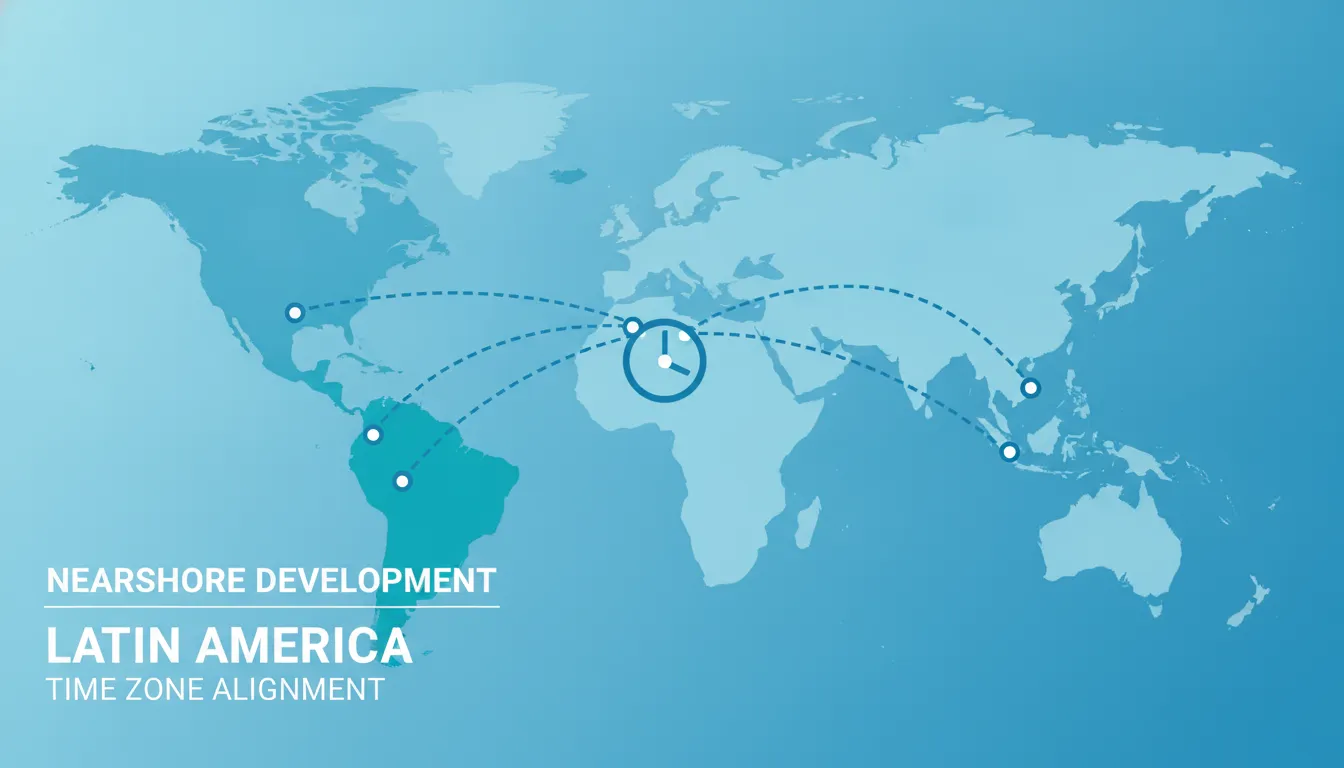
Nearshore software development is a strategic approach to building engineering capacity. It involves partnering with development teams in geographically close countries. For US-based organizations, this most often means engaging talent in Latin America (LATAM). This model enables synchronous collaboration during business hours while delivering material cost advantages over domestic hiring.
What makes nearshore different from onshore and offshore?
The distinction between nearshore, onshore, and offshore models is fundamental to choosing the right partnership structure. Onshore hiring keeps all work within your country, which maximizes alignment but carries the highest cost. Offshore outsourcing moves work to distant regions with significant time zone gaps, often introducing 8-12 hour communication delays. Nearshore occupies the middle ground by placing your extended team in countries just two to four hours away by flight, sharing the same or adjacent time zones. As the Brookings Institution notes, this proximity enables same-day collaboration while still delivering cost efficiency.
For engineering leaders, geographic strategy is no longer a secondary consideration. Time zone alignment, cultural compatibility, and cost structure are now baseline requirements. Organizations want teams that integrate seamlessly with their existing workflows. Leveraging Agile AI in nearshore software development accelerates these teams further, combining intelligent tooling with close collaboration to drive superior outcomes.
Why the nearshore market is accelerating
The global demand for engineering talent continues to outpace supply. By 2026, the United States may face a shortage of 1.4 million software developers. This structural gap creates persistent challenges for startups and enterprises alike trying to scale their technical organizations. The nearshore market has responded accordingly. The LATAM IT sector is valued at approximately $70.85 billion, with analysts projecting 10-11% annual growth that could bring this market to $126.3 billion by 2030.
Macroeconomic shifts have also accelerated the nearshore trend. Following the COVID-19 pandemic, many organizations recognized that extended supply chains introduce unacceptable risk. Relying on geographically proximate teams serves as a proven risk management strategy that preserves organizational agility. This model has reliably delivered engineering talent within predictable budgets for over a decade.
The LATAM advantage for US-based organizations
Latin America has emerged as the preferred nearshore destination for North American companies. The region offers an optimal combination of technical skill and cost efficiency. Organizations typically save 30-50% on engineering costs compared to US-based hiring. The LATAM engineering workforce shares strong cultural alignment with US business practices, high English proficiency, and familiarity with modern development toolchains. These factors reduce onboarding friction and allow teams to begin delivering value within weeks rather than months.
Not sure which model fits your needs? Schedule a consultation to discuss your project requirements with our delivery team.
Can Staff Augmentation Solve Your Skill Gap?
Staff augmentation is a flexible approach to scaling your engineering team. This model allows you to integrate skilled developers into your existing organizational structure. It is most effective when you have established workflows but need additional capacity or specialized expertise to meet your milestones. You retain full control over project direction and the day-to-day management of augmented team members. This model fills skill gaps rapidly without the extended timeline of traditional full-time recruitment.
Closing technical skill gaps at speed
Engineering leaders frequently encounter sudden requirements for niche expertise. You may need a senior cloud architect for a migration project, a React Native developer for a mobile launch, or a QA specialist to address technical debt. The standard industry hiring cycle of six to ten weeks can derail product timelines. Teravision's staff augmentation services reduce this timeline to just two weeks, keeping your roadmap on track.
Our network spans 180+ pre-vetted engineers across diverse technology stacks. These professionals integrate into your team and operate under your management structure. This model aligns naturally with nearshore software development because you gain real-time collaboration within your working hours without the friction of offshore time zone gaps. Your augmented team members operate on the same schedule as your in-house staff.
Flexible capacity for evolving teams
Engineering requirements shift as products mature. You might need five backend developers during a major release but only two during a maintenance phase. Staff augmentation accommodates these fluctuations. Teravision offers month-to-month terms, providing flexibility without long-term lock-in. This structure enables precise budget management, ensuring you pay only for the capacity you actually need.
Our engineers also receive ongoing AI training that enhances productivity. This investment helps them write cleaner code, reduce defect rates, and deliver faster iterations. Research published by the National Institutes of Health confirms that nearshore models help organizations maintain agility during economic transitions. This approach keeps your engineering organization lean while providing the capacity to tackle significant initiatives.
When Does a Dedicated Development Team Make Sense?
The dedicated team model is the optimal choice for organizations requiring full product ownership without taxing internal management bandwidth. Unlike staff augmentation, which places individual contributors into your existing structure, a dedicated team operates as an autonomous unit. These squads manage every phase of delivery, from architecture decisions through testing and deployment. This structure is particularly effective for greenfield projects or situations where internal leadership is already at capacity. Our AI-powered dedicated teams combine proven delivery frameworks with intelligent tooling to maintain velocity without sacrificing quality.
What defines a cross-functional squad
A true dedicated team includes all the roles required to ship production-ready software. This typically includes software engineers, QA specialists, UX designers, and a Scrum Master or technical project manager. By assembling these competencies within a single unit, we eliminate the handoff friction that slows traditional development cycles. Every squad member maintains deep context on your product goals, business logic, and technical architecture, reducing the knowledge transfer overhead that plagues rotating contractor models.
Ownership of the full delivery lifecycle
When you engage a dedicated team, you are investing in outcomes rather than hours. The squad owns sprint planning, technical decision-making, quality assurance, and delivery timelines. Regular demo sessions ensure alignment and provide opportunities for course correction. This end-to-end ownership model is gaining traction across the industry. Foreign direct investment in Mexico rose 41% in early 2023, driven in part by increased demand for nearshore delivery partnerships. This growth signals that engineering leaders increasingly trust nearshore partners to manage complex, full-scope engagements.
When the dedicated model makes sense
This model is ideal when you are launching a new product, modernizing a legacy system, or executing a major platform migration. It is equally appropriate when your technical leadership team is already stretched thin. Because Teravision provides the tech leads and project managers, your internal team focuses on strategic priorities while we handle execution. The squad takes full accountability for delivery milestones, ensuring every release meets quality standards before reaching your users.

Staff Augmentation vs Dedicated Teams: Key Differences
Selecting the right engagement model is a core component of any nearshore software development strategy. While both approaches provide access to elite Latin American engineering talent, they address fundamentally different organizational needs. The optimal choice depends on your management capacity, project scope, and desired level of control.
Side-by-side comparison
The table below maps the critical distinctions between staff augmentation and dedicated teams across the dimensions that matter most to engineering leaders.
| Dimension | Staff Augmentation | Dedicated Teams |
|---|---|---|
| Management Responsibility | Client manages daily tasks and priorities | Teravision manages sprint planning and delivery |
| Project Ownership | Client retains full ownership and direction | Shared or team-led ownership with defined outcomes |
| Time to Value | Individual placement in 2 weeks | Full squad operational in 2-4 weeks |
| Scaling Model | Add or remove individual contributors | Scale by adding entire squads |
| Cost Structure | Hourly or monthly per engineer | Monthly squad-based pricing |
| Best For | Filling specific skill gaps | End-to-end product delivery |
| Management Overhead | Higher internal oversight required | Lower internal oversight needed |
How to evaluate staff augmentation for your team
Staff augmentation is the right choice when you have a strong internal technical leadership team but lack specific skill sets or need to increase velocity without permanent headcount. This model allows you to fill capability gaps rapidly while avoiding the long-term cost commitments of domestic hiring. Teravision's staff augmentation services provide direct control over your extended team members. You manage their daily priorities and integrate them into your existing engineering culture. This structure performs best when you already have a clear technical roadmap and a product owner who can provide direction.
How to evaluate dedicated teams for your organization
Dedicated teams deliver a complete solution for organizations that need end-to-end product development without taxing internal management. In this model, Teravision assembles a squad that includes developers, QA engineers, and project managers who operate as a cohesive unit. Our AI-powered dedicated teams assume full responsibility for technical outcomes and sprint execution.
This approach is ideal for organizations building new products, modernizing legacy systems, or tackling complex technical initiatives without diverting internal leadership attention. By delegating technical execution to a trusted partner, your core team concentrates on strategic priorities. The dedicated squad handles the full cycle of architecture, development, testing, and deployment.
What Makes Nearshore LATAM Better Than Offshore?
Engineering leaders frequently evaluate nearshore and offshore options based on cost and speed. While offshore providers in distant regions may offer lower hourly rates, time zone misalignment often erodes those savings through reduced collaboration velocity. Latin America has become the preferred sourcing region for culturally aligned nearshore partnerships because it eliminates the structural friction that undermines other models.
Time zone alignment enables real-time workflows
The time zone overlap between LATAM and North America is the single most impactful operational advantage. Teams in Mexico, Colombia, Brazil, and Argentina operate within the same business hours as their US counterparts. This enables synchronous collaboration, real-time problem solving, and immediate feedback loops. The shared working day eliminates the 8-12 hour turnaround cycles that plague offshore arrangements. Key operational benefits include:
- Same-day communication with instant feedback on code reviews and architectural decisions
- Zero-delay standups and sprint ceremonies aligned with your existing calendar
- Real-time pair programming and collaborative debugging sessions
- Immediate escalation paths for production incidents
- Seamless integration with agile ceremonies including daily standups, sprint planning, and retrospectives
Cultural alignment amplifies these time zone advantages. LATAM engineers demonstrate high English fluency and familiarity with North American business norms, reducing the communication overhead that often consumes 15-20% of offshore project budgets. Teravision has cultivated this regional expertise over 20 years of nearshore delivery, ensuring every team integration is smooth from day one.
Cost efficiency without compromising talent quality
Cost remains a critical factor in nearshore decisions. Partnering with LATAM providers typically reduces engineering costs by 30-50% compared to US-based hiring, and up to 55% for mid-level and senior roles. Critically, these savings do not correlate with reduced capability. Demand for LATAM engineers increased 250% in 2025 alone, reflecting growing market confidence in the region's talent quality.
Mexico's IT services sector alone was valued at approximately $11.9 billion, representing a deep and mature talent pool. These professionals integrate into your workflows and begin contributing value within weeks, not months.
Infrastructure investment confirms regional maturity
Major technology companies are making substantial long-term commitments to LATAM infrastructure. Amazon Web Services is investing over $5 billion in a new Mexico cloud region over the next 15 years. This infrastructure investment signals that the region is positioned to support complex, enterprise-grade software development for the foreseeable future.
Foreign investment trends reinforce this outlook. Mexico attracted $29 billion in foreign direct investment in the first half of 2023, a 41% year-over-year increase. This capital flow confirms that global organizations view LATAM as a strategic nearshore destination for reducing operational risk while maintaining delivery velocity.
How to Choose Between Staff Augmentation and Dedicated Teams
Selecting the optimal engagement model for nearshore software development requires evaluating your organizational capacity, project complexity, and long-term objectives. Both models offer a two-week ramp-up to begin delivering value quickly, but they serve different structural needs.
Evaluate your management bandwidth
Staff augmentation works effectively when your technical leadership has the capacity to onboard and direct new team members. In this model, you retain control over daily priorities and task allocation. If your engineering managers are already operating at full capacity, a dedicated team is the better option. Dedicated teams handle their own sprint planning, task management, and reporting, freeing your leadership to focus on product strategy and business outcomes.
Define your project scope and complexity
Clear project parameters guide the decision process. Staff augmentation suits well-defined work with specific skill gaps or discrete deliverables. For full product development, platform modernization, or ongoing feature delivery, a dedicated team provides the comprehensive capability and autonomy required for success.
- Assess project complexity: Well-scoped, discrete tasks align with staff augmentation, while multi-phase product builds benefit from the integrated capability of a dedicated squad.
- Evaluate internal capacity: Choose staff augmentation if you have a strong technical lead who can manage extended team members. Choose dedicated teams if your leadership is already at capacity.
- Compare time to impact: Both models start within two weeks, but dedicated teams can address broader scope faster due to their cross-functional composition.
- Analyze cost structure: Staff augmentation offers per-engineer monthly pricing with maximum flexibility. Dedicated teams provide predictable squad-based pricing for sustained initiatives.
- Identify required capabilities: Determine whether you need specialized individual expertise or a full cross-functional unit with QA, design, and project management built in.
Plan for long-term scalability
Nearshore models enable organizations to maintain engineering agility by bypassing slow domestic hiring cycles. You can start with staff augmentation to address immediate gaps and transition to AI-powered dedicated teams as your product requirements expand. This phased approach lets you scale engineering capacity in lockstep with business growth, optimizing both cost and velocity at every stage.
Talk to our team about your specific needs. Book a Discovery Call to discuss which model aligns with your project requirements and timeline.
Frequently Asked Questions
How does the USMCA affect nearshore software development?
The USMCA trade agreement establishes a structured framework for digital commerce between the United States and Mexico. Its digital trade chapter provides clear guidelines for software code transfer, digital product classification, and cross-border data storage. According to the Brookings Institution, these provisions protect electronic signatures and digital transactions, giving engineering leaders greater confidence when engaging teams in Mexico. This legal infrastructure ensures that intellectual property and operational data receive consistent protection throughout the engagement.
Do nearshore software development partners offer month-to-month contracts?
Many nearshore providers offer flexible engagement terms to accommodate changing organizational needs. Teravision Technologies provides month-to-month contracts for staff augmentation engagements, eliminating the risk of long-term lock-in. This structure allows you to add or reduce engineering capacity based on current project demands. Making it particularly suitable for startups and growth-stage companies that need to manage cash flow while accessing top-tier talent.
What is AI-native delivery in nearshore software development?
AI-native delivery represents an evolution in software development methodology. It incorporates artificial intelligence tools throughout the development lifecycle, including code generation, automated testing, sprint planning optimization, and deployment automation. Industry analysts at HatchWorks identify this capability as a key differentiator for evaluating nearshore partners in 2026. At Teravision, AI-native frameworks enable teams to deliver products three to five times faster than traditional approaches by augmenting human expertise with intelligent automation.
Can nearshore software development teams work in my time zone?
Time zone alignment is a defining advantage of the nearshore model. Most LATAM development hubs operate within Eastern, Central, or Mountain time zones, directly matching US business hours. Teams in Colombia, Mexico, and Brazil, for example, share overlapping working days with their North American counterparts, enabling real-time collaboration, immediate code reviews, and synchronous sprint ceremonies. According to Arc.dev, this proximity eliminates the communication latency that undermines offshore arrangements.
Does nearshore software development support cloud migration projects?
Nearshore teams are increasingly engaged for cloud infrastructure initiatives. Major cloud providers are expanding their LATAM presence, with Amazon Web Services committing over $5 billion to new Mexican cloud regions. This Trade.gov data confirms that the region offers the technical infrastructure required for complex cloud migration, data center consolidation, and DevOps transformation projects. Nearshore teams leverage local data center availability to reduce latency and maintain compliance with regional data residency requirements.
Ready to Scale Your Nearshore Development Team?
Delaying your engineering expansion means ceding market position to competitors who move faster. With Teravision, you can add elite nearshore engineering talent in as little as two weeks, bypassing the six-to-ten-week industry standard. Whether you need specialized individual contributors through staff augmentation or a fully autonomous dedicated squad, our proven framework delivers measurable results.
Book a Discovery Call to discuss your project with our delivery team. We will help you evaluate whether staff augmentation or a dedicated team aligns with your technical requirements, timeline, and budget.
- staff augmentation
- dedicated teams
- nearshore software development
Related Articles

Set up a Discovery Call with us today and start working with Teravision, a company with 20+ years of experience in the software industry and Development Centers in Mexico and Colombia



Dedicated Software Teams
Augmented Teams
What's the Difference